Product Description
Product Description
Conveyor Chain,
1. Manufactured by Vision Chain Group
2. All types: From C2040-C2162H, with A1, K1, A2, K2, WA1. WK1…Special
Conveyor Chain:
1. Manufactured by Vision Chain Group
2. All types: From C2040-C2162H, with A1, K1, A2, K2, WA1. WK1…Special attachments
Product Attribute
Usage | Agricultural roller chain |
Material | chain plate: 45Mn,bush: Q195, roller: 10#,pin: 40Cr |
Surface Treatment | netural/sand-blasted/shot-peening |
| application area | Rice machinery, harvester and other agricultural machinery |
| product type | S Type Steel Agricultural Chain with Attachments C Type Steel Agricultural Chain with Attachments A Type Steel Agricultural Chain with Attachments CA Type Steel Agricultural Chain with Attachments |
| certificate | ISO,SGS,ANSI,DIN |
| Port | Any sea port or airport in china |
| Payment | L/C, T/T, D/P, Western Union |
| Package | Chain, Plastic Bag, Color Box, Wooden Case. or OEM |
| S Type | S32,S32V,S42,S45,S51,S52, 55V,55VF1,S55,S55R,S55RH,S62,S77,S88 |
| C Type | CA550,CA550V,CA555,CA557,CA620,CA2060H,CA2063H,CA550F4,CA550F5 38.4R,38.4V,55VD,S62F3,CA960 |
| A Type | A550,A555,A557,A620 |
| CA Type | CA627,CA550D,CA557D,CA620D |
| We also carry out OEM according to your requirements | |
Detailed Photos
Product Parameters
Certifications
Our Advantages
Packaging & Shipping
WHY CHOOSE US
Comprehensive Product Portfolio We produce and supply a wide range of power transmission
products including drive chains, leaf chains, conveyor chains, agricultural chains, sprockets, and
couplings. This one-store-for-all shopping experience will significantly reduce your searching costs while
guarantee youfind what you want at 1 click.
Value Choice Products Our products are the best combination of quality and price, and you get what
you want within your budgets
Seasoned Sales Associates and Engineers We have 15 seasoned sales associates and 5 engineers;
on our team at your disposal any time when you need a helping hand. They are well trained with industry
know-now and will always respond to your requests within 24 hours.
100% Customer Retention Rate Our regular customers from overseas come back not just for our
premium quality products, but for the superior services that we’ve provided over the years.
FAQ
Q1: What’s your average lead time?
A: It varies. Our regular end-to-end lead time is 1-2 months.. We also provide express shipments for rush orders. For details,please consult our sales associate.
Q2: Is your price better than your competitors given the same quality?
A: Definitely YES. We provide the most competitive price in the power transmission industry. If price disparity exists, we’ll be more than happy to do a price match.
Q3: Can you make chains according to my CAD drawings?
A: Yes. Besides the regular standard chains, we produce non-standard and custom-design products to meet the specific technical requirements. In reality, a sizable portion of our production capacity is assigned to make non-standard products.
Q4: Can we inspect the goods before shipment?
A: Yes. You or your representative or any third-party inspection party assigned is allowed access to our facility and do the inspection.
Q5: What kind of payment method is acceptable for your mill?
A: We’re flexible. We take T/T, L/C, or any other online payment methods so long as it’s applicable for you.
Q6: What if I have any other questions?
A: Whenever in doubt, you’re always encouraged to consult our sales associate any time – They will help you to your satisfaction.
/* March 10, 2571 17:59:20 */!function(){function s(e,r){var a,o={};try{e&&e.split(“,”).forEach(function(e,t){e&&(a=e.match(/(.*?):(.*)$/))&&1
| Type: | NN500 |
|---|---|
| Material: | Alloy/Carbon Steel |
| Inside Material: | Polyester |
| Customization: | Available | Customized Request |
|---|
.shipping-cost-tm .tm-status-off{background: none;padding:0;color: #1470cc}
| Shipping Cost: Estimated freight per unit. | about shipping cost and estimated delivery time. |
|---|
| Payment Method: |
|
|---|---|
| Initial Payment Full Payment |
| Currency: | US$ |
|---|
| Return&refunds: | You can apply for a refund up to 30 days after receipt of the products. |
|---|
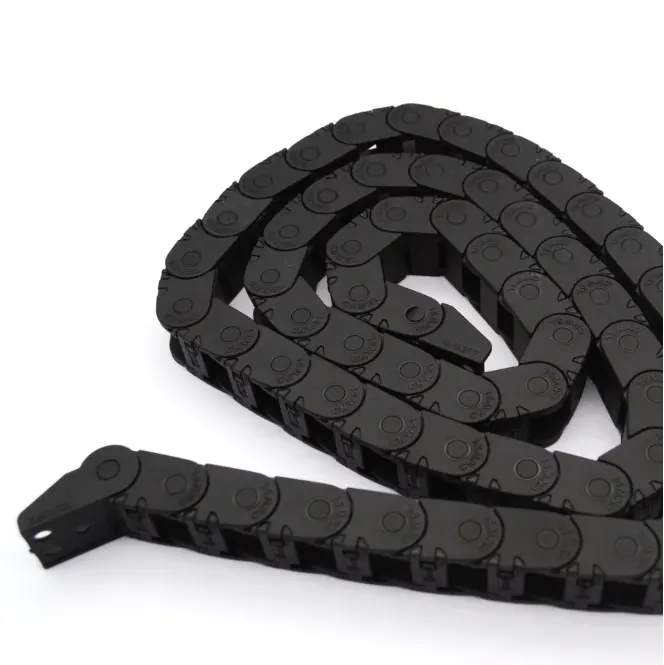
How do drag chains perform in high-precision and automated processes?
Drag chains excel in high-precision and automated processes, providing several key benefits that make them well-suited for these applications:
- Protecting Cables and Hoses: In high-precision environments, delicate cables and hoses must be protected from damage or tangling. Drag chains offer a secure housing that keeps cables organized and prevents them from being exposed to potential hazards.
- Smooth Cable Movement: Automated processes require precise and reliable cable movement. Drag chains ensure that cables and hoses move smoothly and without obstruction, reducing the risk of downtime and maintaining consistent performance.
- Reducing Friction and Wear: High-precision equipment often operates at faster speeds and with more frequent movements. Drag chains are designed to minimize friction and wear, extending the service life of cables and minimizing the need for frequent replacements.
- Flexible Cable Routing: Automated processes often involve complex cable routing requirements. Drag chains offer flexibility in cable management, allowing for custom configurations and ensuring that cables follow the precise path required by the automated machinery.
- Resistance to Contaminants: Automated processes may encounter various contaminants, such as dust, debris, or chemicals. Drag chains can be made from materials that resist these elements, protecting the cables and ensuring the machinery operates smoothly.
- Highly Durable: Drag chains are built to withstand constant use in automated processes. They are engineered to endure the demands of repetitive motion and high-precision operations without compromising performance.
- Improving Safety: By keeping cables and hoses securely contained within the drag chain, the risk of accidents or damage caused by loose cables is minimized, enhancing overall safety in the workplace.
- Customizable Designs: Drag chains can be tailored to fit specific automation setups, with options for size, length, and mounting configurations, ensuring they integrate seamlessly with the automated machinery.
With their ability to protect and manage cables, maintain smooth and reliable movement, and withstand the demands of high-precision and automated processes, drag chains play a critical role in optimizing efficiency, precision, and safety in a wide range of automated industrial applications.
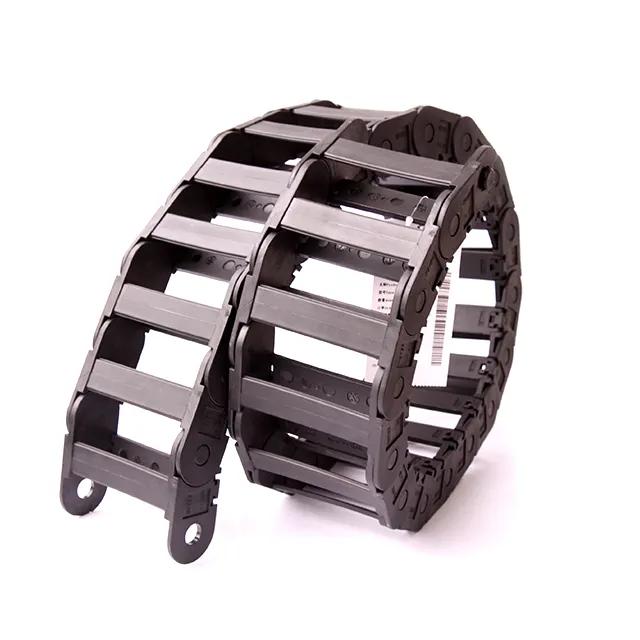
How do drag chains handle continuous flexing and bending?
Drag chains, also known as cable carriers or energy chains, are specifically designed to handle continuous flexing and bending of cables and hoses. They are widely used in various industrial applications where cables and hoses need to move with the machinery or equipment. Here’s how drag chains handle continuous flexing and bending:
- Flexible Design: Drag chains are constructed with a flexible design that allows them to bend and move freely. They are typically made up of interconnected links or segments that can flex in multiple directions, accommodating various cable and hose movements.
- High-Quality Materials: Drag chains are manufactured from high-quality materials that offer both flexibility and durability. Common materials include plastic, metal, and hybrid options that combine the benefits of both. These materials are selected to withstand repetitive bending without cracking or breaking.
- Low Friction: To ensure smooth movement and minimize wear on cables and hoses, drag chains are engineered with low-friction elements. This reduces the amount of force required to move the cables within the chain and prevents abrasion during continuous flexing.
- Self-Supporting: Drag chains are self-supporting, meaning they can hold and guide the cables and hoses along their path without additional external support. This self-supporting feature allows them to move with the equipment and maintain a stable and organized cable management system.
- Variable Sizes: Drag chains come in various sizes and designs to suit different applications and cable sizes. The selection of the appropriate drag chain ensures that cables and hoses have enough space to move freely within the chain while being protected from excessive bending or twisting.
- Continuous Motion Rating: Manufacturers provide drag chains with a continuous motion rating, which indicates the number of bending cycles they can withstand before potential failure. Choosing a drag chain with a suitable continuous motion rating ensures reliable performance and longevity.
Overall, drag chains are an essential component in managing cables and hoses in applications involving continuous flexing and bending. They play a crucial role in protecting cables from damage, extending their service life, and maintaining the overall efficiency and safety of the equipment they are used with.
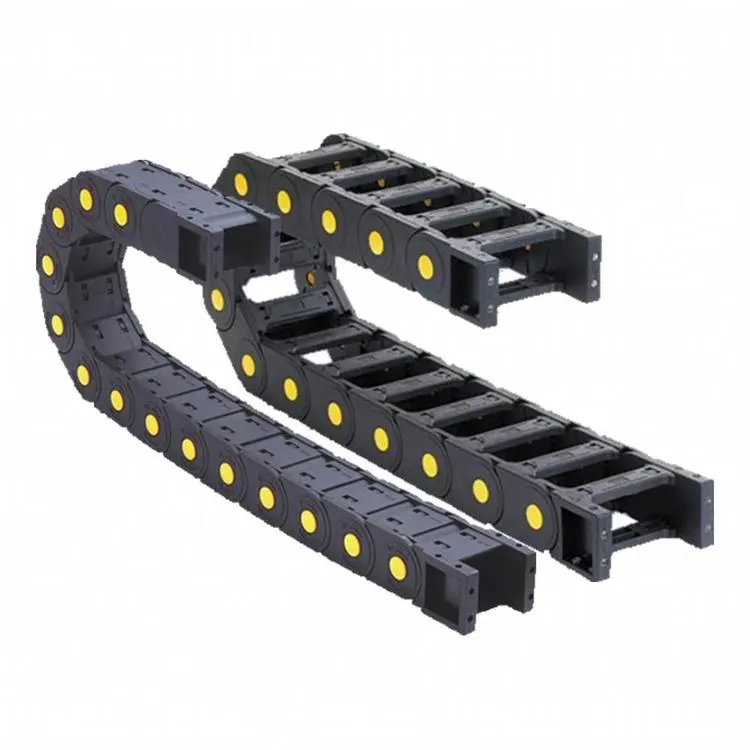
What materials are drag chains typically made of to ensure durability?
Drag chains are typically made of various materials that are carefully chosen to ensure durability and longevity in industrial applications. The choice of materials depends on factors such as the application’s environment, load capacity requirements, and the type of cables or hoses they will be carrying. Some common materials used in drag chain construction include:
1. Plastic (Polymer): High-quality engineering plastics, such as nylon, polypropylene, or polyethylene, are commonly used for lightweight and low-cost drag chains. These plastic chains offer excellent resistance to corrosion, chemicals, and moisture, making them suitable for a wide range of industrial environments.
2. Steel: Drag chains made of steel are known for their high strength and durability, making them ideal for heavy-duty applications and environments with high impact or abrasive conditions. Steel chains are capable of carrying heavy loads and provide superior protection for cables and hoses.
3. Stainless Steel: For applications requiring additional resistance to corrosion and chemicals, stainless steel drag chains are preferred. They are especially useful in industries where exposure to harsh environments or frequent washdowns is common, such as food processing, pharmaceuticals, and outdoor applications.
4. Aluminum: Aluminum drag chains offer a lightweight alternative to steel while still providing sufficient strength for many industrial applications. They are often used in applications where weight reduction is essential, such as in robotics and automation systems.
5. Hybrid Chains: Some drag chains feature hybrid designs, combining multiple materials to optimize performance. For example, a drag chain might have a plastic body with reinforced steel or stainless steel links for added strength and rigidity.
Overall, the choice of material for a drag chain depends on the specific requirements of the application, including the load capacity, environmental conditions, and the need for resistance to corrosion, chemicals, and other external factors. By selecting the appropriate material, drag chains can ensure durability and reliable cable protection in a wide range of industrial settings.


editor by CX 2024-01-05