Product Description
Standard Double Pitch Conveyor Chain Double Pitch Pintle Drag Drive Roller Conveyor Sprocket Chain For Food Machine
Product Description
Roller chain or bush roller chain is the type of chain drive most commonly used for transmission of mechanical power on many kinds of domestic, industrial, and agricultural machinery, including conveyors, wire- and tube-drawing machines, printing presses, cars, motorcycles, and bicycles. It consists of a series of short cylindrical rollers held together by side links. It is driven by a toothed wheel called a sprocket. It is a simple, reliable, and efficient means of power transmission. ANSI Standard Short Pitch Power Transmission Roller Chains are the most popular chains for driving, transmission reduction, tension, shuttle traction, and other applications.
Product Parameters
| Transmission chain (Driving Chain) | Short Pitch Precision Roller Chain (A Series)(1,2,3) | 04C-1 06C-1-2-3 085-1-2-3 08A-1-2-3 10A-1-2-3 12A-1-2-3 16A-1-2-3 20A-1-2-3 24A-1-2-3 28A-1-2-3 32A-1-2-3 40A-1-2-3 48A-1-2-3 |
| 25 35 35-2 35-3 -2 40-3 50 50-2-50-3 60 60-2 60-3 80 80-2 80-3 100 100-2 100-3 120 120-2 120-3 140 140-2 160 160-2 -2 240 | ||
| Short Pitch Precision Roller Chain (B Series)(1,2,3) | 06B-1-2-3 06B-1-2-3 08B-1-2-3 10B-1-2-3 12B-1-2-3 16B-1-2-3 20B-1-2-3 24B-1-2-3 28B-1-2-3 32B-1-2-3 40B-1-2-3 48B-1-2-3 56B-1-2-3 64B-1-2-3 72B-1-2-3 | |
| Heavy Duty Series Roller Chain(1,2) | 08AH-1 10AH-1 12AH-1-2-3 16AH-1-2-3 20AH-1-2-3 24AH-1-2-3 28AH-1-2-3 32AH-1-2-3 40AH-1-2-3 | |
| Side Bow Chain | 40SB 43SB 50SB 60SB 63SB 80SB 08BSB 08BSBY1 10BSB 12BSB C2050SB | |
| Motorcycle Chain | 410 415 415H 420 420H 428 428H 520 520H 525 525H 530 530H 630 630H | |
| Engine Mechanism Chain (Timing Chain) | CL04 | |
| Self-Lubrication Roller Chain | 08BSLR 10BSLR 12BSLR 16BSLR 40SLR 50SLR 60SLR 80SLR | |
| Double Pitch Transmission Chain | 208A 208B 210A 210B 212A 212B 216A 216B 220A 220B | |
| 2040 2050 2060 2080 2100 | ||
| Bush Chain | P15F-B P20-B P25-B P25F1-B P30F2-B P36-B P40-B P45-B P50-B P55-B P60-B P70-B P80-B | |
| Conveyor Chain | Roller Chain With Straight Side Plates (A Series) | C08A-1-2-3 C10A-1-2-3 C12-1-2-3 C24A-1-2-3 C32A-1-2-3 |
| C35 C40-1-2-3 C50-1-2-3 C80-1-2-3 C100-1-2-3 C120-1-2-3 C140-1-2-3 C160-1-2-3 | ||
| Roller Chain With Straight Side Plates (B Series) | C08B-1-2-3 C10B-1-2-3 C12B-1-2-3 C16-1-2-3 C20B-1-2-3 C24B-1-2-3 C28B-1-2-3 C32B-1-2-3 | |
| Double Pitch Conveyor Chain | C208A C208AH C208B C208BL C210A C210AL C212A C212AH C212AHL C216A C216AL C216AH C216AHL C220A C220AL C220AH C220AHL C224A C224AL C224AH C224AHL C232A C232AL C232AH C232AHL | |
| C2050 C2052 C2060 C2062 C2060H C2080 C2080H C2082 C2082H C2100 C2100H C2102 C2102H C2120 C2120H C2122 C2122H C2160 C2160H C2162 C2162H | ||
| Double Pius Speed Chain | BS25-C206B BS25-C208A BS25-C210A BS25-C212A BS30-C206B BS30-C208B BS30-C210B BS30-C212B | |
| Conveyor Chain (M Series) | M20 M28 M40 M56 M80 | |
| Hollow Pin Conveyor Chain (MC Series) | MC28 MC56 MC112 MC224 | |
| Conveyor Chain (FV Series) | FV40 FV63 FV90 FV112 FV140 | |
| Conveyor Chain (FVT Series) | FVT40 FVT63 FVT90 FVT112 FVT140 FVT180 FVT250 FVT315 | |
| Hollow Pin Conveyor Chain (FVC Series) | FVC63 FVC90 FVC112 FVC140 FVC180 FVC250 FVC315 | |
| Conveyor Chain (Z Series) | Z40 Z100 Z160 Z300 | |
| Conveyor Chain (ZE Series) | ZE40 ZE100 ZE160 ZE300 | |
| Hollow Pin Conveyor Chain (ZC Series) | ZC21 ZC40 ZC60 ZC150 ZC300 | |
| Hollow Pin Chains | 08BHPF 08BHPF5 08BHP9 10BHPF3 10BHPF4 12BHPF2 12BHPF3 16BHPF3 16BHPF4 40HP 08BHPF7 08BHP 50HP 50HPF4 50H-HP 60HP 60HPF1 80HP 80HPF1 80HPF2 80H-HP 80HPF3 80HPF4 HB41.75F5 A2080HP | |
| Welded-type cranked link chains | WR78 WH78 WR82 WH82 WR106 WH106 WR110 WH110 WR111 WH111 WR124 WH124 WR132 WH132 WR150 WH150 WR155 WH155 WR157 WH157 WR78F5 WH78F4 WH124F1 WH111F1 | |
| Palm oil Chains | P101.6F2 P152F14 P152F17 P152F29 90R-S P101.6F64 P76.7 P152F31 | |
| Sugar mill chains | DH9063 DH2198 P152F93K2 P152F78K2 DH 0571 0 DH1796 P152F77-AS2 P203.2F9 | |
| Rubber gloves carrier chains | P100F155 P100F13 P100F139 P150/90 | |
| Lumber conveyor chains | 81X 81XH 81XHE 81XHH 81XHS 500R 441.100R | |
| Sharp top chains | 08AF34 08BF21 10AF8 41F6 06BF1 06BF37 08AF41 08BF44 08AF8… | |
| Stainless Steel Chain | Stainless Steel Short Pitch Precision Roller Chain(A Series) | 25SS-1 35SS-1 41SS-1 40SS-1 50SS-1 60SS-1 80SS-1 100SS-1 120SS-1 |
| Stainless Steel Short Pitch Precision Roller Chain(B Series) | 05BSS-1 06BSS-1 08BSS-1 10BSS-1 12BSS-1 16BSS-1 20BSS-1 24BSS-1 | |
| Stainless Steel Roller Chain With Straight Side Plates | C40SS-1 C50SS-1 C60SS-1 C80SS-1 C100SS-1 C120SS-1 C08BSS-1 C10BSS-1 C12BSS-1 C16BSS-1 C20BSS-1 C24BSS-1 | |
| Stainless Steel Double Pitch Transmission Chain | 2040SS 2050SS 2060SS 2080SS 2100SS 2120SS 208BSS 210BSS 212BSS 216BSS 220BSS 224BSS | |
| Stainless Steel Double Pitch Conveyor Chain | C2040SS C2040HSS C208BSS C2050SS C2060SS C2060HSS C2080SS C2080HSS C2100SS C2100HSS C2120SS C2120HSS | |
| Stainless Steel Hollow Pin Chain | 08BHFSS 40HPSS 50HPSS 60HPSS 12BHPSS 80HPSS C2040HPSS C2050HPSS C2060HPSS C2080HPSS HB50.8SS | |
| Stainless Steel Double Pitch Hollow Pin Chain | C2042HPSS C2052HPSS C2062HPSS C2082HPSS C2042H-HPSS C2052H-HPSS C2062H-HPSS C2082H-HPSS | |
| Lifting Chain | Car Parking Chain | 12AT-1 16AT-1-2 20AT-1-2-3 24AT-1-2 |
| Leaf Chain | LH0822 LH0823 LH571 LH0844 LH0846 LH 0571 LH1571 LH1571 LH1034 LH1044 LH1046 LH1066 LH1088 LH1222 LH1223 LH1234 LH1244 LH1246 LH1266 LH1288 | |
| BL422 BL423 BL434 BL444 BL446 BL466 BL488 BL522 BL523 BL534 BL544 BL546 BL566 BL588 BL622 BL623 BL634 BL644 BL646 BL666 BL688 | ||
| Multile Plate Bearing Pin Chain | LF30 MP50F2 MP50.8 MP70F1 MP70F2 MP70F3 MP80F1 MP90F1 MP90F2 MP110F1 | |
| Rollerless Lift Chain | 45-1 55-1 65-1 85-1 105-1 125-1 145-1 165-1 | |
| Agricultural Chain | S Type Steel Agricultural Chain & Attachments | S32 S42 S45 S52 S55 S62 S77 S88 A550 A620 |
| C Type Steel Agricultural Chain with Attachments | CA550 CA550/S55 CA555 CA550HD CA550V CA557 CA620 CA2801 38.1R 38.4R 38.4V 38.4VB | |
| Rice Harvester Chain | S3558T-48001 S3558T-48002 | |
| Drop Forged Chain Series | Drop Forged Rivetless Chain | Imperial: 80H X348 X458 468H X658 X678 678 698 998 9118 S348 S458 S678 S698 S9118, Metric system: XT100 XT160 |
| Cast Detachable Chain | 55 57 62 74 78 | |
| Steel Detachable Chain | 25 32 32W 51 52 55 62 | |
| Cast Iron Chain | Cast Iron Chain (C Series) | C55 C55L C77 C188 C188L C102B C111 C131 C132 |
| Cast Iron Chain (H Series) | H60 H78 H82 H110 | |
| Cast Iron Chain (4 Series) | 462 477 488 4103 720 720S 730 | |
| Cast Iron Chain BRH188 | BRH188 C188CP C102B-K2 C55A C55B C55D CC600 H78A H78B H130 H138 MC33 103 4103F29 907-E51 | |
| Welded chains | WR78 WH78 WR82 WH82 WR124 WH124 | |
| Forging Hanging Chain | X228 X348 X458 X678 698 |
Detailed Photos
FAQ
Q: Do you provide samples?
A: Yes. A sample is available for testing.
Q: What’s your lead time?
A: Standard products need 5-30days, a bit longer for customized products.
Q: Do you provide technical support?
A: Yes. Our company has a design and development team, and we can provide technical support if you
need.
Q: How to ship to us?
A: It is available by air, sea, or train.
Q: How to pay the money?
A: T/T and L/C are preferred, with different currencies, including USD, EUR, RMB, etc.
Q: How can I know if the product is suitable for me?
A: >1ST confirm drawing and specification >2nd test sample >3rd start mass production.
Q: Can I come to your company to visit?
A: Yes, you are welcome to visit us at any time.
Q: How shall we contact you?
A: You can send an inquiry directly, and we will respond within 24 hours.
| Shipping Cost: Estimated freight per unit. | To be negotiated |
|---|
| Standard or Nonstandard: | Standard |
|---|---|
| Application: | Textile Machinery, Garment Machinery, Conveyer Equipment, Packaging Machinery, Electric Cars, Motorcycle, Food Machinery, Agricultural Machinery |
| Surface Treatment: | Chrome Plating |
| Samples: | US$ 10/Meter 1 Meter(Min.Order) | Order Sample |
|---|
| Customization: | Available | Customized Request |
|---|

Can drag chains be used in shipbuilding and marine applications?
Yes, drag chains can be used in shipbuilding and marine applications, and they offer several advantages in these environments:
- Protection of Cables and Hoses: Drag chains are used to protect cables, hoses, and other components from damage caused by exposure to harsh marine conditions, such as saltwater, high humidity, and extreme temperatures.
- Corrosion Resistance: Drag chains made from materials like stainless steel or other corrosion-resistant alloys are well-suited for marine applications where exposure to saltwater and moisture is common. They can withstand corrosion and maintain their structural integrity over time.
- Flexible Cable Management: Shipbuilding and marine applications often involve complex cable and hose routing to power various systems and equipment. Drag chains provide a flexible and organized solution for managing these cables, ensuring they move smoothly during vessel operation.
- High Strength: Drag chains used in shipbuilding are designed to withstand heavy loads and dynamic forces that may be encountered during rough seas or harsh weather conditions.
- Reliable Performance: Marine environments demand reliable and robust equipment. Drag chains are engineered to provide consistent performance, protecting critical cables and ensuring the uninterrupted operation of essential systems on the ship.
- Long Service Life: Quality drag chains can have a long service life, which reduces maintenance efforts and replacement costs for shipbuilders and operators.
- Fire Resistance: Some drag chains can be manufactured to be fire-resistant, an essential feature for safety compliance in shipbuilding and marine applications.
- Customizable Solutions: Drag chains can be customized to fit the specific cable management needs of different shipbuilding projects, accommodating various cable sizes and routing requirements.
Due to their ability to protect cables and hoses, resist corrosion, and withstand the demanding conditions of marine environments, drag chains are widely used in shipbuilding, offshore platforms, marine vessels, and other maritime applications. They play a crucial role in ensuring the reliability and safety of electrical and fluid systems on ships and maritime structures.
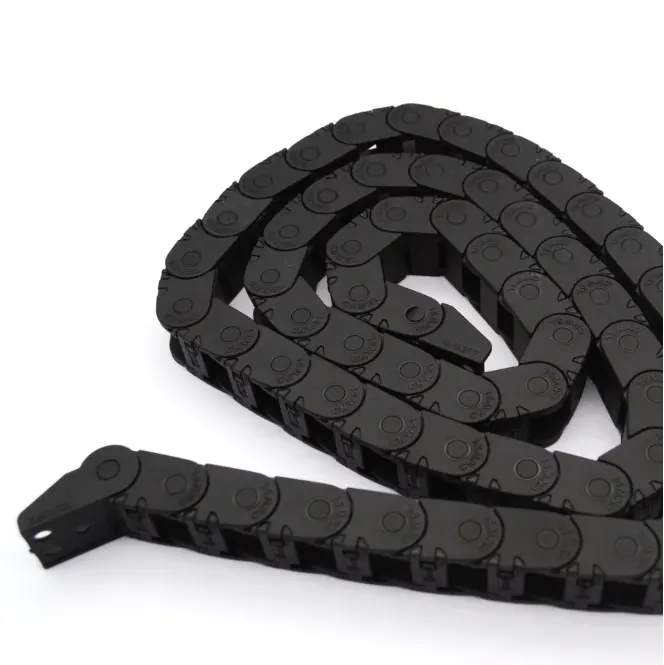
What are the limitations of using drag chains in certain applications?
While drag chains offer numerous advantages in cable management and protection, they also have certain limitations that need to be considered when selecting and using them in specific applications. Here are some limitations:
1. Limited Flexibility:
Drag chains are designed to move in a linear or slightly curved path. They may not be suitable for applications that require high flexibility or intricate routing of cables in multiple directions.
2. Size and Space Constraints:
For applications with limited space, finding the right-sized drag chain that can accommodate all the necessary cables and hoses without causing overcrowding can be a challenge.
3. Weight Restrictions:
Heavy-duty drag chains can handle significant loads, but there are weight limits for each type and size of chain. Exceeding these limits can lead to premature wear and reduced performance.
4. Noise and Vibration:
In high-speed or dynamic applications, the movement of drag chains can generate noise and vibration, which might affect the overall system performance or require additional noise-damping measures.
5. Maintenance:
While drag chains reduce cable wear and maintenance needs, they still require regular inspection and maintenance to ensure they function optimally. Neglecting maintenance can lead to unexpected failures.
6. Temperature Limits:
Some drag chains have temperature limitations. High-temperature environments can cause drag chains to degrade or lose their structural integrity, impacting their performance and lifespan.
7. Chemical Resistance:
Exposure to certain chemicals can deteriorate the material of the drag chain. Selecting the appropriate material with chemical resistance is crucial in chemical or corrosive environments.
8. Environmental Exposure:
In outdoor applications, drag chains are exposed to weather conditions such as rain, snow, and UV radiation, which can affect their durability over time.
9. Cost:
Drag chains can be more expensive compared to other cable management solutions. The initial investment should be weighed against the benefits they provide.
10. Compatibility:
Ensuring compatibility between the drag chain, cables, and hoses is essential to prevent friction, abrasion, or damage to the cables.
Despite these limitations, drag chains remain highly versatile and widely used in various industrial applications for cable management and protection.
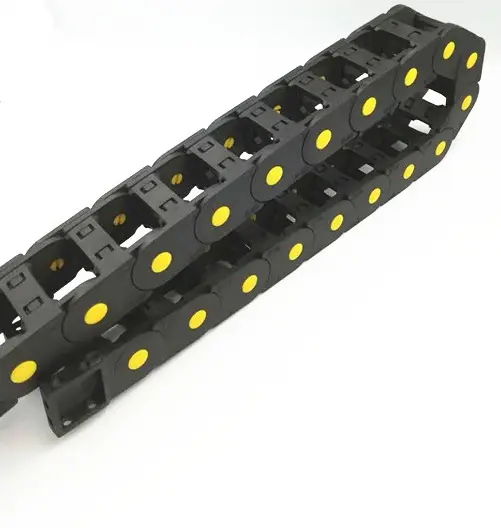
Can drag chains handle heavy loads and protect cables in dynamic environments?
Yes, drag chains are designed to handle heavy loads and provide effective cable protection in dynamic environments commonly found in industrial applications.
Drag chains are constructed from durable and robust materials, such as plastic or metal, which enables them to withstand the weight of numerous cables and hoses. They are engineered to carry a variety of cables, including power cables, data cables, hydraulic hoses, and pneumatic lines, all within a single chain structure.
The design and construction of drag chains allow them to operate smoothly in dynamic environments, where there are constant movements, vibrations, and changes in motion. They can handle multi-axis movement, such as back-and-forth, side-to-side, and rotational motions, without compromising cable protection.
Drag chains utilize flexible links that allow for bending and twisting, ensuring that the cables inside can move freely and follow the motion of the connected machinery or equipment. This flexibility prevents cable fatigue and reduces the risk of damage caused by repetitive motion or constant tension.
In dynamic environments, where machinery or equipment experiences rapid acceleration and deceleration, drag chains play a crucial role in keeping the cables organized and preventing them from tangling or snagging. They act as a reliable cable carrier, guiding the cables along the intended path and protecting them from potential hazards.
Furthermore, drag chains are equipped with various mounting options and brackets to secure them to the equipment securely. This anchoring ensures that the drag chain remains in place even during fast-paced movements, providing consistent cable protection and preventing unnecessary strain on the cables.
In summary, drag chains are well-suited for handling heavy loads and providing effective cable protection in dynamic industrial environments. They offer flexibility, durability, and reliable cable management, making them a vital component in ensuring the longevity and optimal performance of cables in various industrial settings.


editor by CX 2023-08-10